
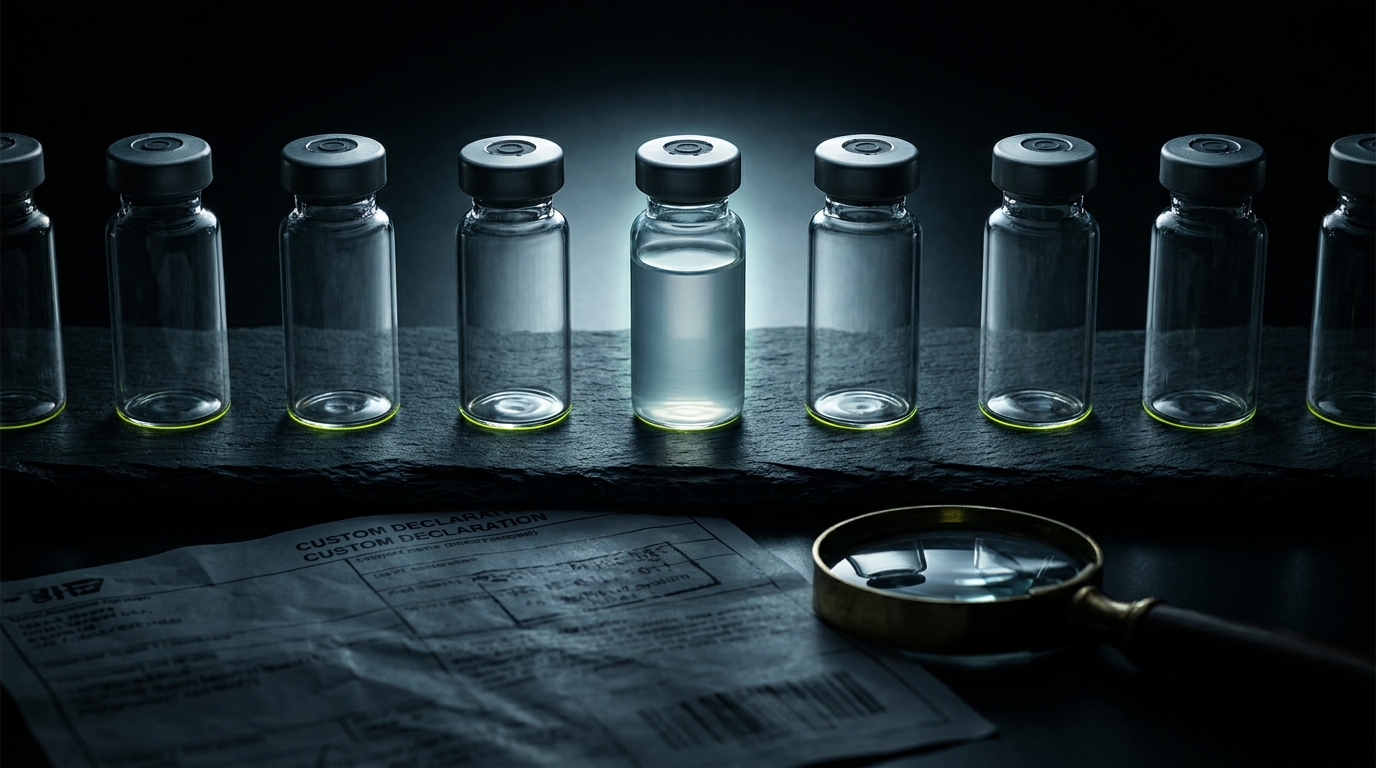
Are Research Peptides From China Safe? A 2026 Buyer's Risk Guide | Peptadex
Educational content. Not medical advice. Consult a qualified healthcare professional before acting on any information in this article. Full disclaimer.
Why This Question Suddenly Matters
In March and April 2026, CNN, TIME, NPR (via WBUR), and several other mainstream outlets all published features on the unregulated peptide market. The dominant narrative: a multi-billion-dollar gray market sourced largely from Chinese chemical factories has emerged in parallel with the FDA's reclassification of certain peptides. The same week the FDA was easing restrictions, the press was raising alarms about what consumers are actually receiving.
Both stories are true at the same time. Understanding the risks requires separating what's anecdote, what's measurable, and what's known from third-party testing of products in circulation.
Key Takeaways
- The majority of "research peptides" sold online originate from Chinese active pharmaceutical ingredient (API) manufacturers
- Independent lab testing has documented vials with peptide content ranging from 0% to over 100% of labeled dose
- Bacterial endotoxin contamination is the most clinically significant safety risk, more dangerous than purity per se
- "Pharmaceutical grade" and "USP grade" are not regulated terms when applied to research peptides
- The FDA's compounding pathway is the legitimate alternative for several peptides reclassified in 2026
Where Research Peptides Come From
Most peptide synthesis at scale happens at solid-phase peptide synthesis (SPPS) facilities. China hosts a high concentration of these — both legitimate API suppliers serving pharmaceutical companies and gray-market suppliers selling directly to "research chemical" distributors. The same factory may produce both pharmaceutical-grade material under contract and lower-cost research material for direct sale, with different specifications and quality controls.
The product reaches US consumers via a chain that typically includes a Chinese manufacturer, a US-based reseller (often labeled as a "research chemical company"), and the end buyer. Each step adds opacity. The reseller usually does not synthesize anything — they purchase, repackage, and resell.
The Three Distinct Safety Risks
1. Identity (Is It The Right Peptide?)
Independent third-party testing — most notably by Janoshik Analytical and a few US labs — has documented vials labeled as one peptide that contained another, or contained no peptide at all. This is rarer for high-volume peptides like BPC-157 and more common for less-recognizable compounds.
2. Purity (How Much of It Is the Peptide?)
Purity refers to what fraction of the powder is the intended peptide versus synthesis byproducts, deletion sequences, and incomplete fragments. Pharmaceutical grade typically requires >98% purity by HPLC. Research-grade material in the gray market commonly tests in the 85–95% range, with some vials lower. The remainder is usually inactive but can include peptide variants with unknown activity.
3. Sterility and Endotoxin Load (Is It Safe to Inject?)
This is the most clinically dangerous category. Peptide powder produced for "research use" is not manufactured to sterile injectable standards. Bacterial endotoxin (lipopolysaccharide) contamination from gram-negative bacteria during synthesis or handling can trigger serious inflammatory and immune responses when injected, even if the powder is "clean" by visual inspection. Endotoxins are heat-stable and not eliminated by typical reconstitution procedures.
This is the single most underappreciated risk in the consumer peptide market. Purity gets discussed; endotoxin load rarely does. See peptide safety: side effects and contraindications for related context.
What Mainstream Coverage Got Right and Wrong
Got Right
- The supply chain opacity is real — most consumers cannot verify what's in their vial
- Influencer-driven demand has outpaced quality infrastructure
- Adverse event reporting is fragmented and underrepresents incidence
- The dual narrative — FDA easing restrictions while consumers buy unregulated material — is genuinely confusing
Got Wrong or Oversimplified
- "All Chinese peptides are dangerous" — the same factories also supply pharmaceutical companies under different specs
- "FDA approval would solve this" — most peptides under discussion are not on a near-term FDA approval pathway, only the compounding pathway
- Conflating the long-term safety question (do these peptides work and are they safe?) with the immediate quality question (is this specific vial what it says it is?)
How to Evaluate a Peptide Source (If You Are Going to Buy)
This is harm-reduction information, not endorsement. Peptides not on the FDA-approved list are not legal for human use, and the safer path is the compounding pharmacy route described in which peptides are legal to compound in 2026.
Third-Party Testing Reports
Look for vendors that publish recent (within 3 months) Certificates of Analysis from an independent lab — not in-house testing. The COA should include HPLC chromatograms, mass spectrometry confirmation of identity, and an endotoxin limit test (LAL or recombinant Factor C). If the COA only reports purity without endotoxin, that's a red flag.
Batch-Level Specificity
Generic COAs not tied to a specific batch number are nearly worthless. The vial in your hand needs to trace back to the tested batch.
Vendor Transparency
Established vendors disclose their synthesis source, lot numbers, and testing methodology. Vendors that cannot answer "where was this manufactured?" should be avoided.
Reasonable Pricing
Prices substantially below the median for a given peptide class are a flag for diluted or counterfeit product. The economics of legitimate synthesis set a floor — vials priced at half the market average are usually not better deals.
The Legal Compounding Alternative
Following the April 2026 FDA reclassification, several previously gray-market peptides became eligible for licensed compounding pharmacies under physician prescription. See FDA Peptide Reclassification 2026: Complete Guide and Is BPC-157 Legal Again? for the regulatory specifics.
Compounded preparations are made under USP 797 sterile compounding standards, with documented chain of custody from raw API through finished product. The cost is typically higher than gray-market sources, and access requires a prescription, but the safety profile is materially different — particularly on the endotoxin and sterility dimensions.
Bottom Line
The "Chinese peptide" framing is too broad to be useful. The country of origin is not the operative variable — manufacturing standards, endotoxin testing, and supply chain transparency are. A peptide synthesized in China to USP standards under contract for a US pharmacy is fundamentally different from a peptide labeled "research only" sold via a website with no testing documentation. Both can carry the same country-of-origin label.
If you want to use peptides, the compounding pharmacy pathway exists for several, the FDA-approved injectable pathway exists for the GLP-1 class, and the gray market remains the highest-risk option regardless of how the vendor presents itself.
Disclaimer: This article is for harm-reduction and educational purposes. Peptides not approved by the FDA are not legal for human use. Nothing here constitutes medical advice or an endorsement of any particular vendor. Consult a licensed physician before using any peptide product.
Disclaimer: The information provided on Peptadex is for educational and informational purposes only. It is not intended as medical advice, diagnosis, or treatment. Always consult a qualified healthcare professional before making any health-related decisions.
Track Your Peptide Protocols
Log doses, track cycles, and monitor your research with Protocol.
Join WaitlistAdvertisement